By Marcus, Founder & Director, PULSE Digital
Most specialist clinics in Singapore are sold the same growth plan: rank on Google, run Google Ads, repeat. It is a tidy story, and for one or two specialties it even works. For most, it quietly mistakes a small slice of patient demand for the whole pie.
Here is the uncomfortable arithmetic. In a referral-driven, insurance-mediated healthcare system, the majority of a specialist’s new patients arrive through channels that have little to do with search. A GP sends them. An Integrated Shield Plan panel routes them. A former patient refers a family member. A hospital affiliation puts the clinic in front of an admitting decision. Google frequently captures the final click, then takes credit for demand it never created.
There is a second reason search does less heavy lifting for specialists than it does for an aesthetic brand or an e-commerce shop. Singapore’s Healthcare Services (Advertisement) Regulations 2021 remove the exact levers that make consumer advertising convert: no testimonials in advertising, no before-and-after results, no “best” or “most advanced,” no discounts or manufactured urgency. So even when a specialist does appear on Google, the field is deliberately flattened. You cannot out-shout a competitor the way a retailer can.
None of this is an argument against marketing. It is an argument for a different kind of marketing. For most specialties, search and advertising are not where demand is born. They are how the demand you already earn through referrals and reputation gets captured before it leaks to a competitor, and how that reputation reaches more of the right people, faster than word of mouth can carry it on its own. The strongest clinics do not choose between referrals and marketing. They use marketing to make their referral engine compound.
This guide maps the full engine: the five channels that actually bring specialists patients in Singapore, how patient search is shifting to AI answer engines, how the mix changes by specialty, how to build a website that serves referrals rather than chases cold clicks, and the metrics worth tracking once you stop staring at keyword rankings.
A note on sourcing: Regulatory points reference Singapore’s HCSA Advertisement Regulations and related MOH guidance (linked at the end). Channel-mix patterns reflect what we observe running search and paid media for Singapore specialist and aesthetic clinics, and are offered as practitioner judgement, not as published statistics. Treatment and clinical decisions sit with you; this is a marketing strategy piece, not medical advice.
1. Why most specialists overestimate Google traffic
Most specialists overestimate Google because they confuse the last click with the source of demand.
In Singapore’s system, a large share of “organic” patients were referred by a GP or a friend and simply Googled the clinic’s name to find the address. That is reputation showing up as search, not search generating new demand.
Four forces make Google a smaller channel for specialists than the dashboards suggest.
The system is referral-first by design.
Many patients see a GP before a specialist, partly out of habit, partly because that is how the private pathway and many insurance arrangements are structured. The GP’s recommendation, not a search result, is what determines where most patients land. The specialist who is top of a GP’s mental shortlist wins the patient before any search happens.
High intent is not the same as high volume.
Patients Google “acne treatment” or “snoring clinic” in large numbers. Almost nobody Googles “oral and maxillofacial surgeon” before their dentist tells them to. For several specialties, true non-branded search volume (people discovering you cold) is thin. You can rank first for a term that thirty people a month search, while your real pipeline runs through a dozen referring doctors you have never optimised for.
HCSA flattens the persuasion advantage.
Under the Advertisement Regulations, specialists cannot deploy the conversion tactics that make consumer ads work. No patient testimonials in advertising. No before-and-after images. No superlatives such as “leading” or “latest.” No promotions or urgency. The penalties are real, with fines of up to S$20,000, up to twelve months’ imprisonment, and a further daily fine for continuing breaches, and the clinic carries the liability even when an agency wrote the copy. The upshot: even where you do show up on Google, you are competing on a flatter field where shouting is illegal, so the edge moves to trust signals that live off-page.
Branded search inflates the win.
Open Google Search Console and split branded from non-branded queries. For most specialist clinics, the impressive “organic” numbers are people typing the doctor’s name. Useful to capture, but it is downstream of a referral or a recommendation. The non-branded discovery traffic, the part Google actually generates, is usually a fraction of the total.
None of this means search is worthless, or that marketing is. It means search is one cylinder in a five-cylinder engine, and for most specialties it is not the largest one. The point is what marketing is actually for. For a specialist, its job is rarely to manufacture demand from nothing. It is to capture the demand your reputation already creates before a competitor does, and to make that reputation travel further and faster than it ever could one conversation at a time.
2. AI search has changed how patients find specialists
Patient search behaviour has shifted from typing keywords into Google to asking questions of AI. People now self-triage and self-diagnose with ChatGPT, Gemini, Perplexity and Google’s AI Overviews, often getting an answer, and a shortlist, without clicking a single website. For specialists, this is not a future trend to monitor. It is already reshaping the start of the patient journey.
The behaviour is different in kind, not just degree. Instead of a keyword and ten blue links, a patient asks a full question in plain language, then keeps the conversation going: “I keep getting a clicking jaw and headaches, what could be causing it and who treats that in Singapore?” The AI explains the likely conditions, suggests what kind of specialist to see, and increasingly names clinics or doctors. Much of this is zero-click: the patient forms a view about what is wrong and who to see before they ever reach a website. Health is one of the largest categories of AI questions precisely because so many journeys begin with “is this serious?” and “should I see someone?”, the exact questions AI now answers directly.
This matters more for specialists than for almost any other business, for three reasons. First, if AI is doing the triage and the shortlisting, then being absent or wrongly described in AI answers means you are invisible at the moment a patient is deciding whether and where to seek care. Second, it shapes referrals too: when a GP sends a patient your way, that patient often asks an AI assistant whether the clinic or doctor is right for their problem, so your AI footprint helps decide whether the referral converts. Third, and usefully, you cannot buy your way into AI answers with ads, testimonials or superlatives. AI surfaces sources it can read, trust and corroborate, which means the compliant, factual, authoritative content specialists are actually allowed to publish is exactly what wins here. For once, the HCSA constraints and the optimisation strategy point in the same direction.
Being visible in AI answers is a distinct discipline, sometimes called answer engine optimisation (AEO) or generative engine optimisation (GEO), and it is not the same as ranking a page in classic SEO. The target is to be the answer, not just a result. In practice it rewards content an AI can extract and stand behind: clear question-and-answer formats, plain-language condition and procedure explainers, your sub-specialty and the conditions you treat named explicitly, structured data so machines understand your pages, and consistent, corroborated information about you across your site, directories and professional profiles so the models agree on who you are and what you do. Brochure copy and vague positioning are invisible to this system; specific, well-structured, authoritative content is what gets cited.
The practical first step is simply to look. Ask ChatGPT, Perplexity and Google’s AI Overviews the questions your patients ask, about your conditions and about your own name, and see what they say and whether you appear at all. The gaps you find are the brief. For most specialists this is now too important to leave to chance, and it is where a deliberate AEO and content strategy earns its place alongside referrals and reputation.
3. The five patient acquisition channels
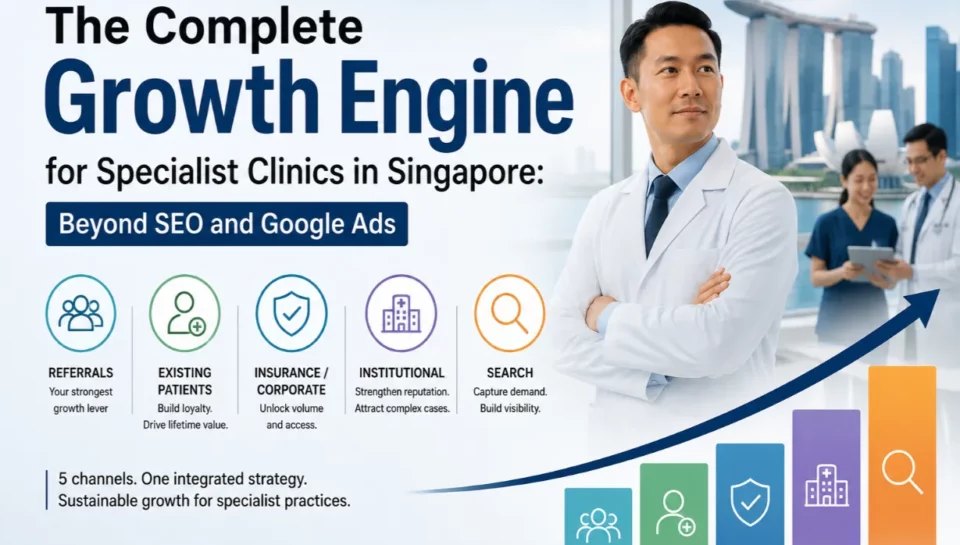
Specialist growth runs on five channels: search, referrals, existing patients, insurance and corporate access, and institutional relationships. The clinics that compound treat these as a portfolio and invest by specialty, rather than pouring the whole budget into the one channel an agency happens to sell.
Search
Search is the only channel that brings genuinely new, non-referred demand: a patient with a problem, no doctor in mind, looking for help. It covers organic SEO, Google Ads, and increasingly the AI answer engines (ChatGPT, Perplexity, Google’s AI Overviews) that patients now use to shortlist clinics. Its strength is reach into people who do not yet know you. For specialists, it does something else that matters just as much: it captures the patients your referrals and reputation send looking for you by name, and it carries your expertise to people the referral network has not yet reached. Its limits for specialists are the thin volume in some fields and the HCSA constraints on what you can say. Search rewards patient, educational content far more than promotional copy, which happens to align with what the regulations permit anyway.
Referrals
Referrals are the backbone of specialist practice: high-intent, high-conversion patients sent by GPs, by other specialists, and by allied health practitioners such as physiotherapists, dentists, and optometrists. A referred patient arrives pre-qualified and pre-trusting, so consult-to-procedure conversion is far higher than for a cold search lead. This is a relationship channel, built through responsiveness, clear referral pathways, prompt and useful reply letters, and genuine clinical reputation among peers. It is slow to build and almost impossible for a competitor to buy away once established. It is also the channel most specialists under-invest in, because it does not come with a dashboard.
Existing patients
Existing patients are the cheapest revenue a clinic will ever earn, through three routes: clinical recalls and surveillance (the defining economics of fields like gastroenterology and dermatology), reactivation of dormant patients, and word-of-mouth referrals of family and friends. A patient who returns for a surveillance colonoscopy, or refers a sibling, costs almost nothing to acquire and converts at the highest rate of any source. Most clinics have a sizeable bank of past patients they never systematically recall or re-engage. Under HCSA, communicating with your own existing patients is also far less constrained than advertising to strangers.
Insurance and corporate access
Being on the right Integrated Shield Plan panels, and in front of corporate and health-screening channels, shapes patient flow in ways no amount of SEO can. About two-thirds of Singapore residents hold an Integrated Shield Plan on top of universal MediShield Life coverage, and for higher-cost procedures a patient’s panel, pre-authorisation, and Letter of Guarantee often decide where they are treated. Panel participation, employee-benefit and corporate screening tie-ups, and concierge or third-party administrator relationships function as distribution. Control sits largely with insurers and intermediaries, so this channel is less dialable than the others, but for procedure-heavy specialties it can dwarf search.
Institutional relationships
Institutional relationships are the prestige-and-pipeline channel: admitting rights and visiting consultant positions at private hospitals, multidisciplinary tumour boards and care teams, teaching and training roles, and society or college involvement. These put a specialist in the room where complex cases are routed and where peer referrals originate. They build slowly and cannot be bought, but they generate a steady stream of exactly the high-acuity cases a specialist wants, and they reinforce every other channel by lending authority.
| Channel | What it delivers | Your control | Time to impact | HCSA / compliance load |
|---|---|---|---|---|
| Search | New, non-referred demand | Moderate | Fast (Ads), 3–9 months (SEO) | High (content tightly regulated) |
| Referrals | Steady, high-conversion patients | Moderate (relationship-based) | Months to build | Low (professional, B2B) |
| Existing patients | Lowest-cost revenue, recalls, word of mouth | High | Immediate | Low (own-patient comms) |
| Insurance / corporate | Volume and payer access | Low (insurer-led) | Slow | Low–moderate |
| Institutional | Prestige and complex-case pipeline | Low | Slow | Low |
4. Which channels matter most by specialty
The right channel mix shifts along a spectrum, from referral-dominated specialties like oral and maxillofacial surgery, where search barely registers, to dermatology, where consumer search genuinely drives the practice. Spend follows that spectrum. The matrix below ranks each channel 1 (most important) to 5 (least) for five common specialties.
| Specialty | Referrals | Existing patients | Insurance / corporate | Institutional | Search |
|---|---|---|---|---|---|
| ENT | 1 | 3 | 4 | 5 | 2 |
| Orthopaedics | 1 | 5 | 3 | 2 | 4 |
| Specialty | Referrals | Existing patients | Insurance / corporate | Institutional | Search |
|---|---|---|---|---|---|
| Gastroenterology | 1 | 2 | 3 | 5 | 4 |
| Oral & Maxillofacial Surgery | 1 | 4 | 3 | 2 | 5 |
| Dermatology | 3 | 2 | 4 | 5 | 1 |
ENT
A genuine two-channel specialty. GP and paediatrician referrals lead, especially for surgery and children, but consumer search is unusually strong because so many ENT concerns are self-identified: snoring and sleep apnoea, blocked sinuses, allergic rhinitis, hearing loss, vertigo. A patient who has not slept properly for months will search before they see anyone. ENT is one of the few specialties where investing seriously in both referrals and search is justified.
Orthopaedics
Two sub-markets pull in different directions. Sports and soft-tissue injuries are searchable and often arrive through physiotherapy and sports-medicine networks. The high-value work, joint replacement and spine surgery, comes through GP and emergency referrals, insurance pathways, and admitting rights at private hospitals. Referrals and institutional relationships carry the practice; search captures the lower-acuity end. Insurance matters because the big procedures are costly and IP-mediated.
Gastroenterology
Defined by screening and surveillance. GP referrals for scopes and symptoms lead, but the standout feature is the value of existing patients: surveillance colonoscopy recalls, chronic disease monitoring (reflux, IBD, hepatitis B), and screening packages create a recurring base that most specialties lack. Corporate and insurance-linked health screening adds volume. Search plays a supporting role around symptom queries and screening intent.
Oral & Maxillofacial Surgery
The clearest case that search is almost irrelevant. Patients are sent by dentists and orthodontists for wisdom teeth, implants, and orthognathic (jaw) surgery, or arrive through hospital trauma and multidisciplinary pathways. They do not search for a maxillofacial surgeon, because they do not know the term until their dentist uses it. The entire growth strategy here is the dental and orthodontic referral network plus institutional standing. Broad search ads for the specialty term are usually inefficient, because the demand is not in the search box. That does not make digital irrelevant, though. It is where every referred patient and every referring dentist checks the surgeon out, and a strong, credible presence is what turns a referral into a booking and helps a good reputation spread past the dentists who already know them.
Dermatology
The exception that proves the rule. Skin is visible and self-diagnosed, so direct patient search is the lead channel: acne, eczema, rosacea, hair loss, mole and skin-cancer checks, plus the aesthetic crossover. Existing patients rank high because so many conditions are chronic and recurring. Referrals and insurance matter less than in surgical fields. Dermatology is where a well-built, HCSA-compliant search presence earns its keep, which is precisely why it is the specialty most often used to sell every other specialist the same playbook.
5. Building a referral-friendly online presence
For most specialists, a website’s primary job is not to capture cold Google demand. It is to convert referred patients and reassure referring doctors. A patient sent by their GP will still look you up before the appointment. A GP deciding who to refer to will check whether you look credible and whether referring is easy. The site that wins is built for those two readers first.
What a referring doctor wants to see in thirty seconds: your exact sub-specialty and the conditions you take, your credentials and training, a clear and frictionless way to refer (direct line, referral form, email, or fast appointment), and confidence that their patient will be looked after and a useful reply letter will come back. Bury any of that and the referral goes to someone easier to work with.
What a referred patient wants: confirmation they are in the right place (their condition, named and explained in plain language), reassurance about the doctor’s expertise, a sense of what to expect, and practical details such as location, insurance panels, and how to book. Notably, individual practitioner credentials, your degree, fellowship, and specialist accreditation, are not restricted under the advertising rules in the way institutional awards and superlatives are. Your genuine expertise is one of the few strong trust signals you are clearly free to state.
Build the site around these jobs:
Condition and procedure explainers, written to educate.
A credentials-forward doctor profile.
An obvious referral pathway for GPs and allied health.
Insurance and practical clarity.
Technical hygiene that affects everyone.
Readiness for AI answers.
The throughline: specialists win online by being clear, credible, and easy to refer to, not by being loud. The regulations push you toward exactly that, so compliance and effectiveness point the same way.
6. Metrics specialists should actually track
Stop treating keyword rankings and website traffic as primary metrics. Track patient economics by channel instead. Rankings tell you nothing about whether patients walked in, converted, or were worth it. The metrics below answer the only questions that matter: where do patients come from, what do they cost, and what are they worth.
The single highest-leverage change most clinics can make is to ask every new patient, at intake, how they heard about you, and to log it. Without that one habit, every channel claim is guesswork.
| Metric | What it tells you | How to capture |
|---|---|---|
| New patients by source | Your true channel mix | “How did you hear about us?” at intake, plus branded vs non-branded split in Search Console |
| Cost per new patient, by channel | Real efficiency of each channel | Channel spend ÷ attributed new patients |
| Consult-to-procedure rate | Quality of demand and consult conversion | Clinic / EMR records |
| Top-referrer concentration | How fragile your referral base is | Referral log (share from top 3–5 referrers) |
| Repeat-referral rate | Referrer loyalty over time | Referral log, tracked monthly |
| Patient (or referral) lifetime value | What a channel is actually worth | Billings over 12–24 months per source |
| Recall / reactivation rate | Dormant value, vital for gastro and derm | EMR recall and surveillance lists |
| Payer mix (cash / IP / MediSave / corporate) | Revenue resilience | Billing system |
| Review velocity and rating | Reputation trend | Google Business Profile |
| AI answer visibility | Whether LLMs can describe and cite you | Monthly manual checks in ChatGPT and Perplexity |
Two metrics deserve special attention for specialists. Referrer concentration is a hidden risk: if a third of your patients come from one or two GPs, you are one retirement or relationship change away from a revenue shock, and that fragility never shows up in a traffic report. Lifetime value by channel routinely reverses the picture a cost-per-lead view gives you. A referred patient or a recurring surveillance patient can be worth many times a cold search lead, which is why ranking the channels on cost alone leads clinics to defund their best sources.
7. Case examples
The following are representative, anonymised composites drawn from common patterns we see with Singapore specialist clinics. They illustrate principles rather than report specific client results.
A maxillofacial surgeon whose name disappeared at the final step. A newly private OMFS surgeon was getting steady referrals from dentists and orthodontists, but losing a frustrating share of them somewhere between the referral and the booking. The reason showed up the moment you looked the practice up: a thin website, almost no presence, nothing a referring dentist could hand a nervous patient, and a competitor’s ad sitting on the surgeon’s own name. The fix was not to chase broad “maxillofacial surgeon” ads, because that demand barely exists. It was to make the surgeon impossible to lose at the final step: a credible, educational presence built around the procedures dentists actually refer for, clear answers to the questions referred patients ask, ownership of the surgeon’s own branded search so their name pointed to their practice, and content the referring dentists could share with their patients. The referral network did not change. It simply started converting, and the surgeon’s reputation began reaching patients the dentists had not yet sent. Principle: for referral-driven specialties, marketing’s job is to convert and amplify the demand referrals create, not to replace it.
A dermatology clinic where compliant content beat promotion. A medical and aesthetic dermatology practice was running promotional-style ads that flirted with HCSA limits and underperformed. The fix was not to abandon search, because for dermatology search is the lead channel, but to rebuild it around educational content: thorough, plain-language explainers on acne, eczema, hair loss, and skin-cancer checks, with honest descriptions and no outcome claims. The compliant pages outperformed the old promotional copy on ranking and conversion, started surfacing in AI-generated answers, and fed the clinic’s social channels, so the same authority that won search also helped word of mouth travel. Principle: where search genuinely works, education out-converts promotion, amplifies reputation, and keeps you compliant.
A gastroenterology practice whose “Google patients” were mostly its own name. A gastro clinic believed search was its main engine, based on strong organic traffic. Splitting branded from non-branded queries told a different story: most of that traffic was patients typing the clinic’s name after a GP referral, and genuine cold discovery was modest. Rather than read that as a reason to spend less, the clinic treated it as the opportunity it was: own the branded search real estate completely, build authority content that referring GPs would see and that made the practice easier to refer to, and run targeted campaigns to the screening-age audience alongside a systematic recall programme for past patients. The referral and recall engine stayed the engine. Marketing made it visible, referable, and compounding. Principle: when referrals drive demand, marketing’s job is to amplify their reach and convert the patients they send.
Author's note
This piece was written by Marcus Goh, Founder of PULSE Digital, a Singapore performance-marketing agency that works almost exclusively with medical, aesthetic, and specialist clinics. Over roughly a decade in this niche, our team has run Google Ads, Meta campaigns, SEO, and AI-search optimisation for clinics across a range of specialties, and HCSA advertising compliance has been a constant part of the work rather than an afterthought.
The strategic patterns here come from managing those accounts day to day: watching attribution data, seeing which channels convert for which specialty, and learning, often the hard way, where search helps and where it quietly drains a budget. Where this article references regulations, it points to Singapore’s official guidance; where it describes channel behaviour, it reflects practitioner experience and is written as professional judgement.
If you would like a channel-by-channel review of where your own practice’s patients actually come from, that is the kind of work we do.
References and sources:
- Ministry of Health Singapore — Healthcare Services Act and the Healthcare Services (Advertisement) Regulations 2021 (advertising rules, prohibited content, penalties): https://www.moh.gov.sg
- Singapore Statutes Online (AGC) — Healthcare Services (Advertisement) Regulations 2021 (S 1033/2021): https://sso.agc.gov.sg/SL/HSA2020-S1033-2021
- Ministry of Health Singapore — About Integrated Shield Plans: https://www.moh.gov.sg/managing-expenses/schemes-and-subsidies/integrated-shield-plans/about-integrated-shield-plans/
- CPF Board — Healthcare financing (MediShield Life, Integrated Shield Plans): https://www.cpf.gov.sg/member/healthcare-financing
- Integrated Shield Plan coverage figure (~two-thirds of residents, citizens and PRs): industry and MOH reporting; baseline figure as at 2017, broadly stable since.
This article is general marketing strategy information, not legal or medical advice. For specific advertising-compliance questions, refer to MOH guidance or a healthcare lawyer; clinical decisions remain with the treating doctor.
Disclaimer: This article is general marketing strategy information, not legal or medical advice. For specific advertising-compliance questions, refer to MOH guidance or a healthcare lawyer; clinical decisions remain with the treating doctor.